FREE Dispatch Fee on Any Drain Call




Water quality concerns are not the same in every Metro Denver home. Water source, utility treatment, seasonal supply changes, plumbing age, and the materials inside the property can all affect what reaches the tap. One household may be dealing primarily with hardness and scale, while another wants to reduce disinfectant taste, sediment, or a specific contaminant identified through testing.
Heart Heating, Cooling, Plumbing & Electric provides water softener installation, water softener repair, water conditioning, water filter installation, and water filter replacement throughout Metro Denver. We evaluate the water concern, household demand, existing plumbing, and treatment goal before recommending equipment.
Water Treatment for Metro Denver Homes
Much of the Denver area receives treated surface water originating in mountain watersheds, but Metro Denver is served by multiple water providers. Water sources and treatment practices can differ among Denver, Aurora, Lakewood, Centennial, Parker, Castle Rock, and surrounding communities. Some properties outside the central municipal systems may also rely on groundwater or private wells.
Those differences matter when selecting water treatment. Even neighboring homes can have different concerns because of plumbing materials, water-heater condition, service-line composition, filter maintenance, and individual preferences.
Our water treatment services include:
- Water softener installation
- Water softener repair
- Water softener replacement
- Whole-home water conditioning
- Whole-house water filter installation
- Point-of-use filtration
- Drinking-water filtration
- Carbon filtration
- Sediment filtration
- Reverse osmosis system installation
- Water filter replacement
- Filter and treatment-system troubleshooting
- Existing-equipment evaluation
- Water testing for common treatment indicators
We match treatment to the water rather than assuming every home needs a softener, carbon filter, reverse osmosis system, or combination of all three.
Common Water Quality Concerns in Metro Denver
Public utilities treat and monitor drinking water to meet applicable standards. Residential water treatment serves a different purpose: addressing conditions within the home, improving aesthetic qualities, protecting equipment from scale, or reducing specific substances with appropriately certified filtration.
Hardness and Mineral Scale
Water hardness can vary across the metro area and may change with the source blend or season. Hardness is primarily associated with dissolved calcium and magnesium. These minerals are not the same as sediment and cannot be removed effectively with a standard particulate filter.
Hard water may leave:
- White deposits on faucets and showerheads
- Spots on dishes and glassware
- Scale inside kettles and plumbing fixtures
- Mineral accumulation in water heaters
- Reduced soap and detergent performance
- Stiff laundry or residue after washing
- Buildup on humidifiers and other water-using equipment
A properly sized ion-exchange water softener removes hardness minerals before they circulate through the home. The decision should be based on measured hardness, water use, plumbing configuration, and the homeowner’s treatment priorities.
Chloramine Taste and Odor
Denver Water uses chloramine to maintain disinfection through its distribution system. Other local water providers may use chloramine, chlorine, or treatment methods specific to their systems.
Homeowners who dislike a disinfectant taste or odor may benefit from carbon filtration, but filter selection matters. Chloramine reduction generally requires media and contact time designed for chloramine rather than an assumption that any basic carbon cartridge will perform equally well.
A whole-home carbon system can treat water entering the property, while a point-of-use filter can focus on drinking and cooking water. We determine which approach fits the concern and expected flow rate.
Sediment and Visible Particles
Particles at a faucet do not always originate in the municipal supply. Sediment may come from water-main work, a private well, corroded household piping, a deteriorating water heater, or debris released after plumbing service.
Before installing a sediment filter, we consider:
- Whether particles appear in hot water, cold water, or both
- Whether the issue affects one fixture or the entire home
- The condition of the water heater
- Plumbing and service-line materials
- Recent utility or plumbing work
- Whether the property uses municipal water or a well
A filter can capture incoming sediment, but it will not correct a corroded pipe or failing water heater that continues producing debris. Our pipe repair and repiping services address deterioration within the home’s water-distribution system.
Taste, Odor, and Discoloration
Taste, odor, or color can result from several unrelated conditions. Disinfectant residual, stagnant plumbing, water-heater sediment, corrosion, filter exhaustion, and private-well conditions can produce different symptoms that require different solutions.
A sulfur-like odor found only in hot water, for example, may involve the water heater rather than the incoming cold-water supply. Discoloration limited to one fixture may point to a local pipe or faucet condition. Treatment should follow diagnosis rather than relying on one filter for every symptom.
Our team can coordinate water-quality evaluation with water heater repair and installation when the problem appears only in hot water.
Older Plumbing and Lead Concerns
Lead is not added by the water utility. It can enter drinking water through certain service lines, solder, fixtures, or other plumbing materials. Older Denver homes, particularly those built before modern plumbing-material requirements, deserve a more careful review when lead is a concern.
A hardness test or basic water-quality screen cannot establish that water is free of lead. That requires appropriate sampling and laboratory analysis. If testing identifies lead, the response may involve service-line replacement, plumbing changes, and filtration certified for lead reduction.
A general carbon filter or water softener should not be represented as a universal lead solution. The equipment must be selected for the specific contaminant and used within its certified performance limits.
Private-Well Water
Private wells require a different treatment approach because the homeowner is responsible for monitoring the water. Well-water concerns may include hardness, iron, manganese, sediment, staining, odor, microorganisms, or other naturally occurring and site-specific conditions.
Treatment should follow comprehensive laboratory testing. A plumber can install and service treatment equipment, but a basic in-home test does not replace certified analysis when health-related contaminants are a concern.
Water Softener Installation
Professional water softener installation begins with sizing the system for measured hardness and expected household demand. Equipment that is too small may regenerate too frequently or allow hardness through during periods of higher use. Oversized equipment can add unnecessary cost and may operate inefficiently if it is not programmed correctly.
We consider:
- Measured water hardness
- Number of household occupants
- Typical and peak water use
- Plumbing size and available flow
- Equipment location
- Drain and overflow requirements
- Electrical access
- Available installation space
- Bypass-valve placement
- Regeneration settings
- Salt storage and service access
- Outdoor irrigation or fixtures that should remain untreated
A water softener is normally installed where it can treat the intended household supply before water reaches fixtures and water-using appliances. Exterior hose connections and irrigation may be bypassed when softened water is not needed outdoors.
After installation, we program the control valve, check for leaks, initiate or verify regeneration, and confirm that the unit is producing softened water. We also explain salt use, bypass operation, and routine care.
Water Softener Repair
A water softener can appear to be operating while allowing hardness to pass through the system. A full salt tank does not prove that the unit is regenerating correctly, and an empty tank does not always mean the only problem is forgotten salt.
Schedule water softener repair if you notice:
- Scale returning to fixtures
- Spotting on dishes after previous improvement
- Water that no longer feels softened
- Salt levels that never decrease
- Excessive salt use
- Standing water in the brine tank
- Salt bridging or a hardened salt mass
- Regeneration occurring too frequently
- The unit running or draining continuously
- Low water pressure after the softener
- Water leaking around the control valve or tank
- Error codes or a blank display
- Unusual taste after regeneration
Our water softener repair process may include checking the bypass valve, control head, injector, brine line, float assembly, drain line, resin performance, programming, and regeneration cycle. We also test the incoming and treated water when appropriate to determine whether the system is actually removing hardness.
Repair may be practical when the tanks and major components remain serviceable. Water softener replacement may provide better value when the control valve has repeated failures, the resin is no longer performing, the tanks are damaged, or the equipment cannot support the home’s current water demand.
Water Conditioning Options
“Water conditioning” is a broad term that can describe several treatment methods. A conditioner is not automatically the same as a water softener, and not every scale-control product removes hardness minerals.
Depending on the equipment, water conditioning may refer to:
- Ion-exchange softening
- Scale-control media
- Carbon filtration
- Sediment filtration
- Iron or manganese treatment
- pH adjustment
- Ultraviolet disinfection
- Reverse osmosis
- A combined treatment system
Some salt-free systems are designed to alter how hardness minerals behave so they are less likely to form scale under certain conditions. They generally do not remove calcium and magnesium or produce softened water in the same way as ion exchange.
We explain what each proposed system does, what it does not do, and what ongoing service it requires. That distinction helps homeowners avoid purchasing equipment based on broad claims such as “whole-home purification” without knowing which water-quality issue it addresses.
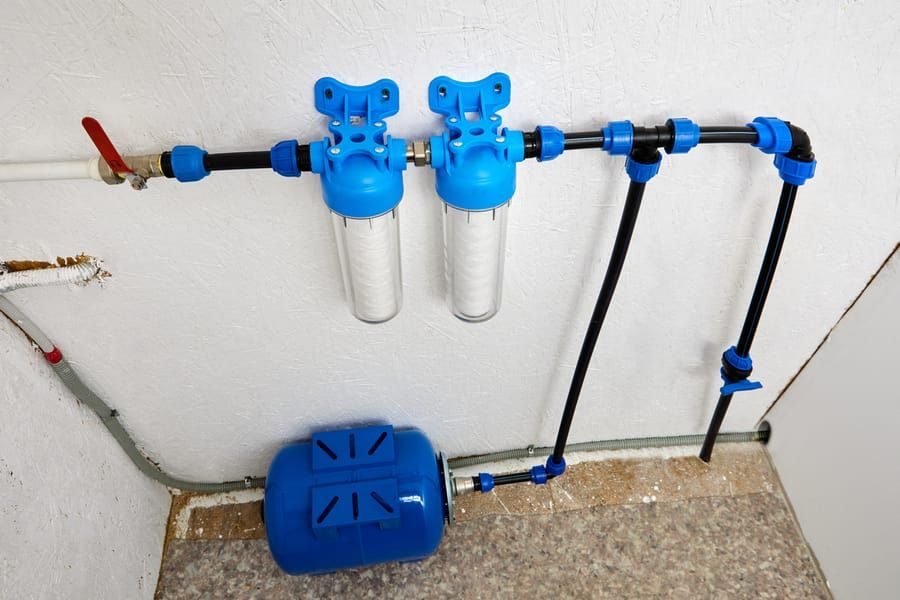
Whole-Home Water Filter Installation
A whole-home filter treats water near the point where it enters the plumbing system. The correct equipment depends on the substance being reduced and the flow required when several fixtures operate at once.
A whole-home water filter installation may include:
- Sediment prefiltration
- Carbon or catalytic carbon filtration
- Specialized treatment media
- Isolation and bypass valves
- Pressure gauges
- Drain connections when required
- Treatment sequencing with an existing softener
- Adequate clearance for media or cartridge replacement
Flow rate is critical. An undersized filter can reduce pressure at showers, faucets, and appliances. Equipment should be selected based on treatment performance at the home’s expected service flow, not only on cartridge dimensions or marketing claims.
Placement also matters when multiple treatment stages are used. Sediment filters, carbon equipment, softeners, and specialty systems must be arranged in an order that protects the equipment and achieves the intended result.
Point-of-Use and Reverse Osmosis Filtration
Not every water concern requires treating every gallon entering the home. Point-of-use filtration can focus treatment on the water used for drinking and cooking.
A reverse osmosis system may be installed beneath a kitchen sink or connected to a dedicated drinking-water faucet. Depending on its certifications and configuration, it may reduce certain dissolved substances that pass through standard sediment and carbon filters.
Reverse osmosis systems require:
- Adequate incoming pressure
- Prefilter and membrane replacement
- A drain connection
- A storage tank or suitable tankless configuration
- Sanitization as recommended
- Verification that replacement components match the system
Water chemistry and treatment goals should guide the decision. Reverse osmosis is not automatically necessary for every municipal-water home, and it is not a substitute for correcting contaminated plumbing or a damaged service line.
Our kitchen plumbing services can coordinate the dedicated faucet, drain connection, and under-sink plumbing involved in point-of-use filter installation.
Water Filter Replacement and Ongoing Service
Water filter replacement is part of system performance, not optional cosmetic maintenance. As media or cartridges accumulate material, treatment effectiveness can decline and flow restriction can increase.
Replacement timing depends on:
- Filter type and media
- Water use
- Incoming sediment
- Contaminant concentration
- Household flow demand
- Manufacturer specifications
- Pressure drop across the filter
- Water-quality changes
- Time since the previous service
A filter should not be assumed to work indefinitely because the water still looks clear. Taste and odor reduction may decline gradually, while some contaminants cannot be detected by sight, smell, or taste.
During water-filter service, we verify the replacement component, inspect seals and housings, check for leaks, and restore the system according to its service procedure. If filters clog unusually quickly, we investigate whether another plumbing or incoming-water condition is increasing the load.
How We Select a Water Treatment System
Our process starts with the concern, not the equipment.
1. Review the Water Symptoms
We discuss scale, spotting, sediment, staining, taste, odor, pressure changes, and the fixtures where the issue appears.
2. Identify the Water Source
We determine whether the property receives municipal water or uses a private well. For municipal systems, the utility’s current water-quality report provides useful background. Private wells generally require broader owner-directed testing.
3. Test the Relevant Conditions
We can test common treatment indicators such as hardness. Health-related contaminants require appropriate laboratory analysis rather than a basic field test.
4. Inspect the Plumbing
We review pipe size, pressure, flow, water-heater condition, service access, drain availability, and any existing treatment equipment.
5. Match Treatment to the Goal
We determine whether the concern calls for softening, sediment removal, carbon filtration, point-of-use treatment, or another verified solution.
6. Size and Install the Equipment
The system is selected around household demand and installed with the required bypasses, drainage, electrical supply, and service clearance.
7. Verify Performance
After installation, we check operation, confirm flow, test treated water when appropriate, and explain maintenance and replacement requirements.
Water Treatment and the Rest of Your Plumbing
Treatment equipment cannot compensate for every plumbing problem. Low pressure may be caused by corroded pipes, a failing pressure regulator, a restricted valve, or an incorrectly sized filter. Discolored hot water may originate in the water heater. Persistent moisture may indicate a leak rather than a filtration issue.
When symptoms point beyond the treatment system, we can coordinate the appropriate service through our full plumbing services. Matching the problem to the correct service prevents unnecessary equipment from being added to the home.
Professional Solutions That Put You First
We provide reliable, people-first service designed to meet your unique needs with care and professionalism. Our team is committed to delivering consistent results, clear communication, and dependable support you can trust. From start to finish, we focus on quality, responsiveness, and building lasting relationships through service delivered with heart.Schedule Water Treatment Service in Metro Denver
Effective water treatment begins with identifying what is actually affecting the water. Hardness, disinfectant taste, sediment, plumbing corrosion, and health-related contaminants require different testing and treatment methods.
Heart Heating, Cooling, Plumbing & Electric provides water softener installation, water softener repair, water conditioning, water filter installation, and water filter replacement throughout Metro Denver. We evaluate the water source, plumbing system, household demand, and treatment objective before recommending equipment.
Schedule water treatment service to have your existing system evaluated, arrange a water softener repair, replace exhausted filtration equipment, or compare treatment options for your home.

Special Offer
$93
Drain Clearing SpecialIncludes basic drain cleaning and a free camera inspection
100 ft. max.
Valid for main and secondary household drains with proper access. Offer cannot be combined with any other promotions, discounts, or special offers. Terms and conditions may apply.
Expires: October 31, 2026
Expires: October 31, 2026
Send Us A Message
Frequently Asked Questions
Reliable, High-Quality Service You Deserve
what people are saying
Quality Service Backed by Real Reviews
Susan Maes
2 days ago

James was very informative.. Answered all our questions and explained everything
Randall Mann
3 days ago
Trenton Barrance did a yearly inspection on my furnace.
He performed a very through inspection and found all was running great.
Trenton was very polite and we had good conversations together.
I'm very pleased with his personality and his work.
I'm very pleased wth Hearth Heating .used them for years
Good company and good people.
Randy Mann
He performed a very through inspection and found all was running great.
Trenton was very polite and we had good conversations together.
I'm very pleased with his personality and his work.
I'm very pleased wth Hearth Heating .used them for years
Good company and good people.
Randy Mann
Steven Benoy
4 days ago
Some hero’s don’t wear capes. James flew into our last minute needs with kindness and skillz!
Simple from start to finish! If afraid of getting burned (or simply staying hot)…call Heart now!
Simple from start to finish! If afraid of getting burned (or simply staying hot)…call Heart now!
Reece Cantrell
4 days ago
Great people that know there products.
Daniel Gay
5 days ago
I called them for a potential water leak because my water bill was unusually high. Justin came to do an assessment and was very honest. Nothing was wrong other than extra daily usage based on the meter etc. I've had bad experiences in the past where auditors try to find something to fix and charge me for unnecessary work. This was not the case with Justin. We discussed some plumbing issues I've had in the past and sold me on getting the cheap subscription which sounds like a great deal. I'll call and set that up next spring when I'm predicting some work to be done on my furnace. I wasn't charged for the inspection. He never acted like it was a waste of his time and was friendly during the entire interaction.
Michael Shufelt
6 days ago
Nic was very professional, cordial. He explained what he was doing and why. He had to get a part that had failed and explained the reason behind the failures. He was respectful. We respect his work ethic, and will and ask for him again.
The Mannings
6 days ago
Trenton performed our annual furnace check up. This is the second year in a row he’s done this service. He’s thorough, professional, and a great communicator. We have trusted Heart with a number of installations in our home (HVAC, hot water heater) and their work is top quality, the products they sell are the best, and their service plan is exceptional.
sharon Lundstrom
6 days ago
Fan/light installed on 20 ft ceiling. Worker were prompt, friendly, efficient, accommodating, and cleaned up. Couldn't have asked for a better experience.
Carin Maher
7 days ago
James Gregory and Heart always do a great job!
Doug Smith
7 days ago
It is our first time using Heart. We’ve had Outstanding service from Daniel. He is conscientious and he explains things very well.
We are going to consider getting the flow tech. We’re leaning heavily in that direction and will make the decision by Monday, 10/12/26.
I don’t know what you’re paying, Daniel, but whatever it is, you’re lucky to have him.
We are going to consider getting the flow tech. We’re leaning heavily in that direction and will make the decision by Monday, 10/12/26.
I don’t know what you’re paying, Daniel, but whatever it is, you’re lucky to have him.
Joe Jenkins
1 week ago
Richard came by today to winterize my swamp cooler. He was quick, thorough, and efficient. I have an annual contract with Heart and it really pays off. I have always had great service from Heart, and Richard was awesome.
Jeffrey Skates
1 week ago
Service was Awsome. The technician was very friendly
Paul Gomez
1 week ago
Trent was awesome and very thorough while servicing our A/C and furnace.
Trent came back to make sure all the numbers were normal and was friendly the whole time. I'll request him in the future.
Ben Miller did a great job servicing our furnace. No complaints.
Trent came back to make sure all the numbers were normal and was friendly the whole time. I'll request him in the future.
Ben Miller did a great job servicing our furnace. No complaints.
Jahred Washington
1 week ago
Daniel C was professional, knowledgeable, and thorough. Highly recommend.
Lance Sommer
1 week ago
Jeremiah was great! Helped us identify a source of leakage underneath our sink and offered a reasonably priced solution which he installed within minutes.
Steven Caputo
1 week ago
David was excellent. Knowledgeable, friendly and conscientious. Work was done as they promised. So glad I chose Heart.
Kenneth Zimmerman
1 week ago
I highly recommend having Heart Heating, Cooling, Plumbing, & Electric take care of all your HVAC needs! Recently, Josh Oliva, Victor Zubia, Justin Anderson, and Jon Estes installed a totally new HVAC system consisting of a new heat pump, a new high-efficiency furnace, and a new evaporator coil to replace our faltering 21-year-old furnace & A/C. The cost was very reasonable and this team worked tirelessly to install it in one day! They also checked to see that our smoke and carbon monoxide detectors were installed & up-to-code! The team was VERY CLEAN & put carpet & wood floor protectors down where they were working! Heart HCP&E are exceptional!!
Kenneth Zimmerman
1 week ago
Trenton Barrance from Heart Heating Cooling Plumbing & Electric did an outstanding job evaluating our 21-year-old furnace to determine if there were any hazardous leaks or other problems requiring repair. Based on his analysis, we decided it was time for a new HVAC system. Trenton is very professional, knowledgeable, and experienced. He also told me about The Heart Care Plan that offers an amazing number of free or discounted services. I highly recommend having Trenton take care of all your HVAC needs!
Get In Touch With Heart Heating, Cooling, Plumbing, Electric
Full Service Home Comfort
Heating, cooling, plumbing, and electrical services come together to support comfort, safety, and reliability throughout your home. From routine care to repairs and system upgrades, each service is handled with attention to detail and a focus on long term performance. Trusted solutions help keep everything running smoothly through every season.