FREE Dispatch Fee on Any Drain Call




Heart Heating, Cooling, Plumbing & Electric provides professional ceiling fan installation, replacement, wiring, and troubleshooting throughout the Denver metro area. Our licensed electricians install indoor and outdoor fans, replace outdated units, add controls, and prepare rooms that do not already have fan-rated wiring or structural support.
Every installation begins with the ceiling, electrical box, wiring, controls, and fan specifications. That allows us to install the fan securely, connect it correctly, and confirm that it operates smoothly at every speed.
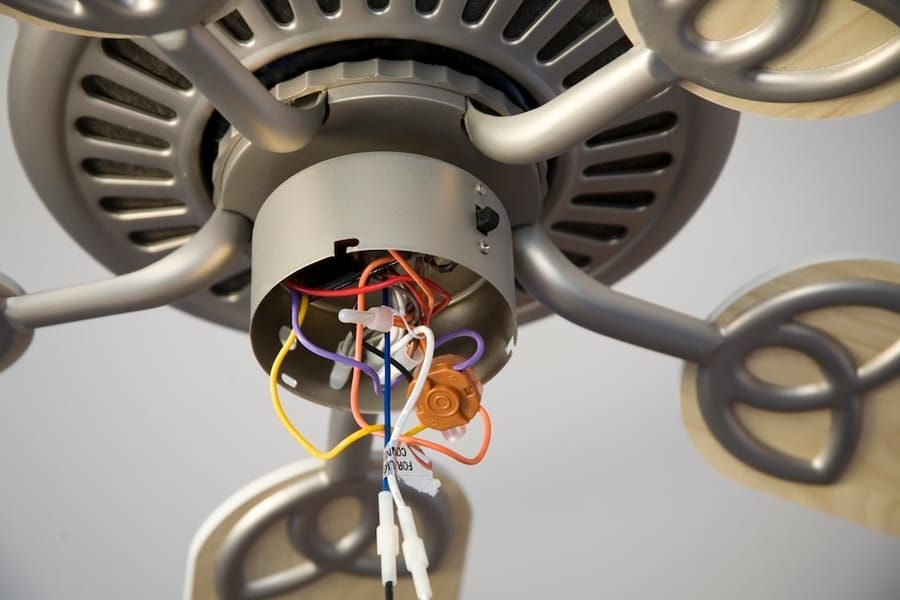
Ceiling Fan Services for Denver-Area Homes
Installing a ceiling fan involves both electrical and structural considerations. The mounting assembly must support the fan’s weight and movement, while the circuit, wiring, controls, and grounding must be appropriate for the selected equipment.
Our ceiling fan services include:
- New ceiling fan installation
- Ceiling fan replacement
- Installation in rooms without an existing fan
- Fan-rated electrical box installation
- New wiring and circuit extensions
- Wall switch and speed-control installation
- Remote-control and smart fan setup
- Ceiling fan troubleshooting
- Light-kit installation and replacement
- Indoor and outdoor fan installation
- High-ceiling and vaulted-ceiling installations
- Fan balancing and operational testing
If the project involves broader fixture or room-lighting changes, our electricians also provide lighting installation services.
New Ceiling Fan Installation
A new fan can be installed where an existing light fixture is located, but the electrical box must be approved to support a ceiling fan. A standard light-fixture box may be unable to withstand the weight, vibration, and rotational forces produced during operation.
Before installing the fan, we evaluate:
- The rating and attachment of the electrical box
- Ceiling construction and available structural support
- Existing wiring and grounding
- Switch and control configuration
- Ceiling height and slope
- Fan weight and mounting requirements
- Blade clearance from walls, doors, cabinets, and fixtures
- Compatibility between the fan, light kit, remote, and wall controls
If the existing box is not fan-rated, we replace it with an appropriate support system. Depending on the location, that may involve a fan brace installed between framing members or a box secured directly to structural framing.
Once installed, we test the fan at each speed, verify light operation when applicable, and check for excessive movement, vibration, or noise.
Installing a Ceiling Fan Where No Fixture Exists
Rooms without existing overhead wiring require more planning than a direct fan replacement. The electrician must determine how power can reach the new location and how the homeowner will control the fan and light.
This work may include:
- Planning the fan location
- Locating ceiling framing
- Installing a fan-rated box and support
- Extending wiring from an appropriate power source
- Adding a wall switch or control
- Separating fan and light functions when feasible
- Making electrical connections and confirming grounding
- Testing the completed installation
Access varies considerably among homes. An unfinished attic may provide a practical route above the ceiling, while finished upper levels, vaulted ceilings, and remodeled spaces can require a different approach. We evaluate access before defining the work so homeowners understand what the installation will involve.
When new controls or nearby receptacles are part of the project, our switch and outlet services can address the related electrical work.
Ceiling Fan Replacement
Replacing an existing fan is often straightforward, but the old mounting arrangement should still be inspected. A fan may have been attached to an undersized box, mounted with loose hardware, or installed using controls that are incompatible with the replacement.
We remove the existing fan and evaluate the box, mounting support, wiring, grounding, switches, and ceiling condition before installing the new equipment. If the replacement fan uses a different canopy, downrod, light kit, or control system, we account for those changes during setup.
Ceiling fan replacement may be appropriate when:
- The motor has become noisy or unreliable
- The fan shakes despite adjustment
- Speed settings no longer work correctly
- Pull chains or controls repeatedly fail
- The light kit flickers or operates intermittently
- The fan is improperly sized for the room
- Replacement parts are unavailable
- The homeowner wants updated controls or styling
- The existing fan is not rated for its location
A malfunction does not always mean the entire fan must be replaced. Our electricians can determine whether the problem involves the fan, wiring, switch, receiver, remote, or electrical connection.
Ceiling Fan Wiring and Controls
Ceiling fans may be operated by pull chains, wall switches, remotes, smart controls, or a combination of these devices. Compatibility matters because not every speed control or dimmer is designed for every fan motor or light source.
Depending on the fan and existing wiring, we can install:
- Separate wall controls for the fan and light
- Combination fan-and-light controls
- Manufacturer-compatible speed controls
- Remote receivers and handheld transmitters
- Smart fan controls
- Standard on-and-off switches
- Compatible dimmers for integrated lighting
Some existing ceiling boxes have only one switched conductor. In that arrangement, independent wall control of the fan and light may require additional wiring or a compatible remote system. We explain the practical options based on the home’s wiring and the selected fan.
Ceiling Fans for Denver’s Climate and Housing
Ceiling fans do not lower a room’s actual temperature. They move air across occupants, which can make the space feel more comfortable. The fan should therefore be turned off when a room is unoccupied unless it is being used for another specific airflow purpose.
During warmer weather, the fan is generally set to push air downward. This can be especially helpful in west-facing rooms, upper floors, lofts, and spaces with large windows that receive substantial afternoon sun.
During the heating season, some homeowners use a low reverse setting to circulate warm air that collects near high ceilings. This can be useful in Denver-area homes with two-story rooms or vaulted ceilings, although fan speed and direction must be selected carefully to avoid creating an uncomfortable draft.
Local home construction also affects installation. Older Denver properties may have shallow or unsupported ceiling boxes, limited grounding, or wiring altered during previous renovations. Newer homes may feature tall ceilings, open floor plans, or integrated controls that require specific fan and mounting configurations.
Choosing the Right Ceiling Fan
Fan selection should account for more than appearance. Blade span, ceiling height, motor design, mounting type, controls, and location all affect how the fan performs.
Important considerations include:
- Room size: A fan that is too small may provide little useful airflow, while an oversized fan can overwhelm a compact room.
- Ceiling height: Standard, flush-mount, and downrod configurations position the blades at different heights.
- Ceiling slope: Vaulted or angled ceilings may require a compatible mounting adapter and longer downrod.
- Blade clearance: The fan needs safe space from walls, doors, cabinets, light fixtures, and other obstructions.
- Control preferences: Wall controls, remotes, pull chains, and smart functions require compatible equipment and wiring.
- Lighting needs: Integrated lights and add-on light kits affect controls, brightness, and electrical configuration.
- Location rating: Fans installed in covered exterior spaces should be damp-rated, while locations exposed directly to weather require wet-rated equipment.
For patios, porches, and other exterior spaces, an indoor-only fan should not be used simply because the area has a roof. Moisture, wind, and temperature exposure should be considered when selecting the equipment and mounting method.
Our Ceiling Fan Installation Process
Our installation process is designed to address both the visible fan and the concealed components supporting it.
- Evaluate the location: We review room dimensions, ceiling height, mounting location, access, and the selected fan.
- Inspect the electrical box and wiring: We confirm that the box is fan-rated, securely supported, and supplied by appropriate wiring.
- Review the controls: We determine how the fan and light will operate and verify that switches, remotes, and speed controls are compatible.
- Prepare the mounting system: We install or correct the fan-rated box, brace, bracket, downrod, or slope adapter as required.
- Assemble and install the fan: Components are assembled according to the equipment requirements and securely mounted.
- Complete the electrical connections: Wiring, grounding, receiver, controls, and lighting connections are completed and enclosed properly.
- Test operation: We test fan speeds, direction, lighting, wall controls, and remote functions.
- Check stability and clearance: The fan is observed in operation for excessive movement, noise, interference, or clearance problems.
We also explain normal operation, control functions, seasonal direction settings, and any manufacturer-specific features before completing the appointment.
Professional Solutions That Put You First
We provide reliable, people-first service designed to meet your unique needs with care and professionalism. Our team is committed to delivering consistent results, clear communication, and dependable support you can trust. From start to finish, we focus on quality, responsiveness, and building lasting relationships through service delivered with heart.Schedule Ceiling Fan Installation in Metro Denver
A ceiling fan should feel stable, operate quietly, and respond correctly to every control. Achieving that result depends on the support above the ceiling, the wiring behind the control, and the compatibility of every installed component.
Heart Heating, Cooling, Plumbing & Electric provides ceiling fan installation, replacement, wiring, and troubleshooting throughout Metro Denver. Whether you are replacing an outdated fan or adding one to a room without existing wiring, our electricians can complete the work with the home’s construction and electrical system in mind.
Schedule ceiling fan service today, or explore our complete electrical services for help with additional electrical repairs and installations.

Special Offer
$49
Whole-Home Electrical Safety InspectionPanel, outlet, breaker, and grounding evaluation.
Offer cannot be combined with any other promotions, discounts, or special offers. Terms and conditions may apply.
Expires: November 30, 2026
Expires: November 30, 2026
Send Us A Message
Frequently Asked Questions
Reliable, High-Quality Service You Deserve
what people are saying
Quality Service Backed by Real Reviews
Nariman Movaffagh
3 days ago

James was amazing and answered all my questions.
Hank Prichard
4 days ago
Very knowledgeable very professional. All my questions were answered Michael and David went above and beyond for me. Will definitely recommend them and Heart
Dino Rojas
4 days ago
Getting the pipe problem fixed
shahla hashemi
5 days ago
I’ll be regular costumer now on. Excellent experience with heart heating, ac, and electric.
Merlynn Bender
1 week ago
5 stars for Jeremiah Stephens on my sewer cleaning. Right guy for that job.
Eddie Huynh
1 week ago
Eli was great. He was fair and honest and made me feel comfortable. He explained everything really well and treated me with respect. Great employee and really honest
Susie Hranicka
1 week ago
Chris did a great job and was so kind, knowledgeable and professional! We have used Heart for hot water heater replacement, kitchen faucet replacement and other plumbing needs! It is a great company to do business with…we are always satisfied!!
Merlynn Bender
1 week ago
Jeremiah did great. On time, the right guy for this job. Thank you.
Dianne Montoya
1 week ago
We purchased our furnace from Heart a couple of years ago. I had regular maintenance done and they went above and beyond. Highly recommend.
Zachary Blackburn
1 week ago
We love being members of Heart. Today, Morgan came out for a fix on our leaky sink and also helped with a cloggy tub. He was extremely knowledgeable and efficient, and I'd have Morgan back out to our house any time!
E Beuler
1 week ago
Larry was as excellent as all their other technicians. He explained what he was connecting electrically. All personnel are terrific! Won’t ever think about using anyone else in the future. I feel very valued as a customer too!
Trenton Barrance serviced my furnace this year and I was equally impressed with his work and communication with me !
Trenton Barrance serviced my furnace this year and I was equally impressed with his work and communication with me !
Bernadette Dixon
1 week ago
Eli and Jeremiah,were AMAZING did such a great job I will definitely share my experience with them to all that are looking for plumbing issues.
Gordon Reichal
2 weeks ago
Professional service. A pleasure to deal with their focus on integrity and quality service.
Maury Kroopnick
2 weeks ago
Knowledgeable, educational, helpful,
quentin Lewis
2 weeks ago
Nick was methodical. Didn't rush into a diagnosis that probably would've cost more. He was awesome!!
Laura Bernstein
2 weeks ago
The team was great! I reached out when my furnace wouldn’t start and heard back right away. They got Joel out to my house within an hour. He took apart the furnace and confirmed that unfortunately it was toast, but got me set up with a quote for what I really wanted, which was a whole new Heat pump system. Victor and Joel got the old furnace out and Nick and the install team got the new one in place with the heat pump. It was a long, late day for the team, but I finally am heating my house again.
Carla Beckman
2 weeks ago
Thanks for sending Joel Ramirez to get my furnace running. Joel is professional, competent, pleasant, efficient.
James Rush
2 weeks ago
Eli did a wonderful job that was one thing after another. He was professional and courteous and did his job well.
Get In Touch With Heart Heating, Cooling, Plumbing, Electric
Full Service Home Comfort
Heating, cooling, plumbing, and electrical services come together to support comfort, safety, and reliability throughout your home. From routine care to repairs and system upgrades, each service is handled with attention to detail and a focus on long term performance. Trusted solutions help keep everything running smoothly through every season.